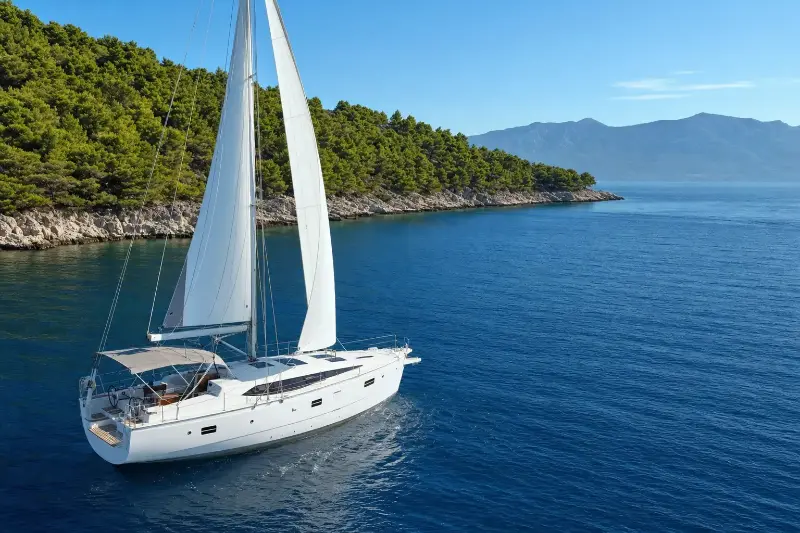
For yacht owners, the Dalmatian Coast has a rare gift: it makes a serious cruising ground feel manageable. Croatia’s Adriatic shore is long, folded and protected by islands, yet many of its best passages are measured in hours, not days. You can leave Split after breakfast, swim off Brač by noon and be tied stern-to in Hvar before dinner. That rhythm is not an accident. It is geography doing owners a favor.
Croatia has more than 1,200 islands, islets, rocks and reefs, though fewer than 50 are inhabited. Along the Dalmatian stretch, from Zadar and Šibenik down to Split, Hvar, Korčula and Dubrovnik, these islands form a natural cruising corridor. The mainland rarely feels too far away, and the next harbor is often visible on the horizon. For families, new owners and experienced skippers who still prefer options, that matters.
"The Croatian promise is simple: big-water beauty without big-water distances."
Short passages, real variety
The great pleasure of the Dalmatian Coast is that it does not ask you to choose between convenience and romance. One day you are threading through the Kornati archipelago, a stark limestone seascape protected as a national park. Another day you are walking the marble lanes of Korčula, often linked to Marco Polo in local tradition, though historians are cautious about the claim. Later, you might anchor near Mljet, whose forested national park surrounds two saltwater lakes.
These are not staged attractions for boaters. They are old places shaped by trade, empire and the sea. Split grew around the Roman Emperor Diocletian’s palace, now a UNESCO World Heritage Site. Dubrovnik’s walls still project the confidence of a maritime republic that once rivaled Venice in diplomacy and commerce. Stari Grad Plain on Hvar, laid out by Greek colonists in the fourth century B.C., remains one of Europe’s best preserved ancient agricultural landscapes.
Marinas that understand yacht owners
Beauty alone does not make a paradise. Yacht owners also need fuel docks that work, electricians who answer the phone, reliable haul-out options and safe berths when the forecast turns ugly. Croatia has spent decades building that infrastructure. ACI, the country’s best-known marina network, operates more than 20 marinas along the Adriatic, supplemented by private marinas, town quays and managed mooring fields.
This network is one reason Croatia punches above its weight in European yachting. In parts of the western Mediterranean, a summer berth can feel like a competitive sport. In Croatia, high season is still busy and prices have risen, especially around Hvar, Dubrovnik and popular national parks. But the density of alternatives gives owners leverage. If one harbor is full, another bay or marina may be within a short motor-sail.
Since Croatia joined the eurozone and the Schengen Area in 2023, life has also become simpler for many European owners. Currency friction is gone, and border procedures are more predictable, though non-EU owners still need to pay close attention to customs rules, VAT status and allowed time in Schengen waters.
The weather is friendly, not harmless
The Adriatic rewards respect. Summer often brings the maestral, a northwesterly sea breeze that builds through the afternoon and eases after sunset. It is one reason morning departures and lazy afternoon swims fit the coast so well. But Croatia also has more forceful characters: the bura, a cold, dry northeasterly that can arrive suddenly and violently, and the jugo, a southeasterly associated with unsettled weather and a long, uncomfortable sea.
Good owners do not romanticize this. They plan. They read local forecasts, study the lee of islands and avoid exposed overnight anchorages when the wind shifts. The reward is confidence. The Dalmatian Coast offers many sheltered bays and harbors, but it is still a real sea, not a theme park with cleats.
Anchoring, mooring and the changing coast
One of Croatia’s best features is also one of its tensions. The coves are seductive: clear water over pale rock, cicadas in the pines, a konoba ashore serving grilled fish and local wine. Yet growth in yacht tourism has brought regulation. Many bays now have concession-run mooring buoys, particularly in popular areas. National parks such as Kornati and Mljet charge entry or boating fees. Posidonia seagrass, crucial for marine life and coastal protection, is easily damaged by careless anchoring.
This is where ownership culture matters. The best skippers are not the ones who boast about finding a free patch of seabed. They are the ones who know when to take a buoy, when to book ahead and when to move on. Croatia’s appeal depends on restraint as much as access.
Why owners keep coming back
Ask yacht owners why Croatia works, and the answers tend to be practical before poetic. The transfer from airport to boat is easy in Split, Zadar and Dubrovnik. Boatyards and charter bases have created a broad marine labor pool. Provisioning is straightforward. Distances are forgiving. A week can feel complete; a month can feel barely enough.
Then the poetry arrives anyway. The light on the stone houses at Vis. The smell of pine after a hot afternoon. The bells in a harbor town while fenders squeak and a ferry washes the quay. Croatia offers the private satisfaction of ownership without isolating you from life ashore. You are not escaping civilization so much as approaching it from its oldest doorway: the sea.
A paradise, with conditions
Is the Dalmatian Coast perfect? No serious cruising ground is. July and August can be crowded. Restaurant quays may expect dinner in exchange for mooring. Popular harbors require advance planning. Some owners will find service costs lower than in parts of Italy or France, but Croatia is no longer a bargain-basement secret. Its popularity has priced in the discovery.
Still, the fundamentals remain exceptional. Few places combine sheltered island sailing, deep history, improving infrastructure and clear-water anchorages so efficiently. For a yacht owner, paradise is not merely a beautiful place. It is a place where the boat gets used, where plans survive contact with weather and where every departure promises another good harbor ahead. On that measure, the Dalmatian Coast is hard to beat.