To sail Ireland well, you must accept a simple truth: the island is not merely a destination. It is a negotiation. Between land and Atlantic, tide and timetable, ambition and prudence, Ireland asks sailors to read the sky as carefully as the chart.
The reward is considerable. Few cruising grounds in Europe offer such a compact mix of drama and hospitality: granite headlands, drowned valleys, island anchorages, working fishing ports, lively yacht clubs and stretches of coast where the next safe harbor feels both reassuringly near and meteorologically far away.
"In Ireland, the forecast is not background noise. It is the itinerary."
The Atlantic Writes the First Draft
Ireland sits squarely in the path of North Atlantic weather systems. The prevailing winds are generally westerly or southwesterly, shaped by depressions moving in from the ocean and by the moderating influence of the Gulf Stream system. That does not mean warm tropical sailing. It means change: a morning of bright clarity can become an afternoon of low cloud, rain and building swell.
This is why the phrase "weather window" matters so much here. A weather window is not simply a nice day. It is a usable interval: wind direction, wind strength, sea state, tide and visibility all aligning long enough for a passage to be made safely and comfortably. In Irish waters, especially on the west coast, a prudent skipper plans around windows rather than dates.
The South Coast: A Civilized Beginning
For many visiting yachts, the south coast is the gentlest introduction. Ports such as Kinsale, Crosshaven and Baltimore are well known among cruising sailors, not because they are tame, but because they combine good shelter with strong maritime culture. Kinsale, near the Old Head, is polished and popular. Crosshaven, at the mouth of Cork Harbour, has a long yachting tradition. Baltimore, further west, feels like a threshold: beyond it, Ireland grows wilder.
Cork Harbour itself is one of the largest natural harbors in the world by area, and it offers the practical comforts sailors value after an offshore leg: fuel, repairs, provisioning and room to breathe. It is also a reminder that Ireland is not only remote coves and postcard villages. It is commercial shipping, naval history, fishing fleets and modern marine infrastructure.
Fastnet and the Psychology of Headlands
Any serious discussion of Ireland by sail eventually reaches Fastnet Rock. The lighthouse, standing on a small islet off County Cork, is one of the most famous marks in offshore racing, known worldwide through the Fastnet Race. But for cruising sailors, Fastnet is less a trophy than a lesson. Headlands accelerate wind. Tidal streams can sharpen seas. A forecast that seems manageable offshore may feel very different when wind opposes tide near rock and shoal.
That is true around much of Ireland. The Blasket Islands, Loop Head, Slyne Head, Erris Head and Malin Head all deserve respect. These names are beautiful on a chart and serious in a passage plan. The old seamanship rule applies: give capes time, sea room and humility.
The West Coast: Beauty With Consequences
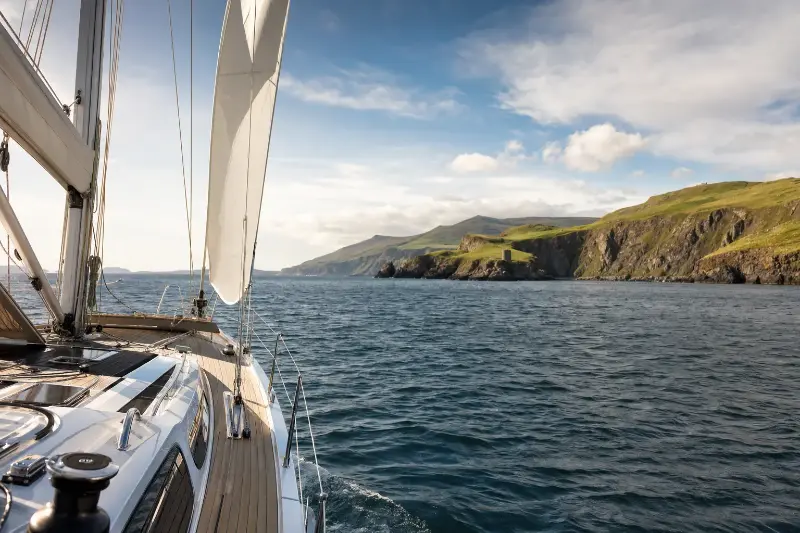
The west coast is the Ireland many sailors dream about: the peninsulas of Kerry, the Blaskets, Dingle, the Aran Islands, Connemara, Clew Bay, Donegal. It is a coast of long Atlantic fetch and sudden shelter, where mountains appear to rise straight from the sea and where a small harbor can feel like a lit room in a vast dark house.
It is also a coast that punishes impatience. Atlantic swell can enter bays long after local wind has eased. Fog can reduce a spectacular landfall to a gray instrument exercise. Tides around island passages can run hard enough to matter, especially for smaller cruising boats. A crew that treats the west as a scenic detour may be surprised. A crew that treats it as ocean sailing close to land will have a better time.
Harbors With Character, Not Just Facilities
Irish cruising is distinguished by the personality of its stops. Dingle offers one of the country’s most appealing harbor towns, with fishing boats, pubs, music and a strong sense of arrival. Galway connects sailing with a city of students, artists and old trading memory. Killybegs, in Donegal, is a major fishing port where visiting yachts share water with serious working vessels. The Aran Islands, when conditions allow, offer limestone, stone walls and a feeling of exposure that is hard to manufacture elsewhere.
This is part of the charm: Ireland’s sailing infrastructure can be uneven, but the human infrastructure is often excellent. Yacht clubs, harbor staff, fishermen and local sailors tend to know their waters intimately. Their advice can be more useful than a glossy brochure. Ask questions. Listen carefully.
Reading the Forecast Like a Local
Met Éireann’s marine forecasts are essential reading, and visiting sailors should also monitor coastal reports, VHF broadcasts and reliable GRIB data. But the Irish coast rewards interpretation, not just information. A forecast southwesterly force 5 may be a brisk reach in one place and an uncomfortable lee shore problem in another. A moderate sea can become sloppy where tidal streams oppose swell. Visibility matters as much as wind when landfall is intricate.
Summer, particularly June through August, generally offers the best cruising odds: longer days, milder temperatures and more frequent usable intervals. But Ireland does not guarantee settled summer weather. Shoulder seasons can be rewarding for experienced crews, though colder water, shorter daylight and fewer services raise the margin of error.
A Sensible Itinerary
The best Irish sailing plans are modular. Instead of promising to reach Donegal from Cork in a fixed week, build an itinerary around clusters: Cork and West Cork; Kerry and Dingle; Galway Bay and the Aran Islands; Mayo and Donegal. Have a primary route, a shorter route and a harbor you would be happy to sit in for two days if the barometer falls.
This is not defeatist. It is how good cruising works. The crew that waits in Baltimore for a fair tide and a kinder wind may enjoy Fastnet in sunlight. The crew that presses on because flights are booked may remember the same coast for entirely different reasons.
The Irish Lesson
Ireland by sail is not a soft-focus romance of green cliffs and Guinness at sunset, though it can certainly include both. It is a serious cruising ground with generous rewards for preparation. The ruggedness is real. So is the welcome. The Atlantic is not an accessory to the trip; it is the central character.
Come with sound ground tackle, good waterproofs, conservative passage plans and a willingness to linger. In return, Ireland offers what many modern sailing destinations have lost: the feeling that landfall still matters, that weather still commands respect, and that a harbor entered at dusk, after a hard but well-judged passage, can feel like one of the great luxuries of the sea.