Tasmania is not a large island on a world map, but it becomes immense from the cockpit of a small yacht. A circumnavigation is roughly 700 nautical miles, more if you linger in its long bays and river mouths, and every mile asks for judgment. This is Australia’s most maritime state: an island below an island, set in the latitudes of the westerlies, with the Southern Ocean pressing hard on its west and south coasts.
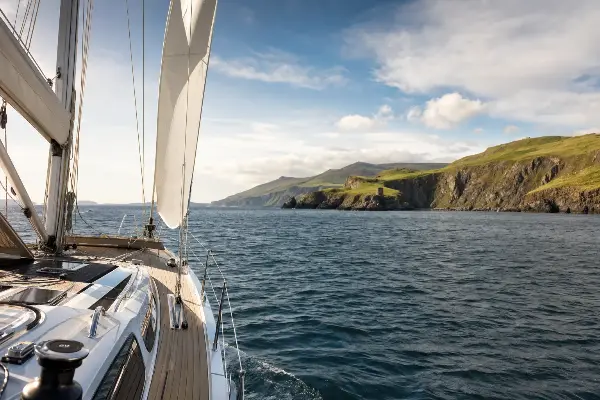
The reward is extraordinary. You can sail beneath cliffs of columnar dolerite, anchor in water the color of black tea, watch albatrosses quartering the swell and enter harbors where there are no roads, no towns and, on some days, no other human beings. Tasmania is wild, remote and beautiful in the old sense of those words: it does not perform for visitors. It simply is.
Why Tasmania Feels Bigger Than It Is
The island lies mostly between 40 and 44 degrees south, close enough to the belt sailors call the "Roaring Forties" to deserve respect. Weather systems move quickly here. A benign morning can become a hard afternoon, and a forecast that looks merely inconvenient in a marina may feel absolute off a lee shore.
That is why experienced skippers talk less about bravery than timing. The best season for most cruising yachts is usually summer into early autumn, roughly December through March, when daylight is long and the odds of settled weather improve. But there is no guaranteed window. Cold fronts still sweep through. Fog can sit down. Swell can wrap around capes. Tasmania punishes schedules more than inexperience; the two together are worse.
"The essential rule is simple: do not sail to a calendar."
The Classic Shape of a Lap
Many yachts begin in Hobart, a natural staging point with repair facilities, provisioning and a proud sailing culture. The city’s identity is tied to the sea, not least because the Sydney to Hobart Yacht Race, first run in 1945, finishes on the River Derwent after crossing Bass Strait and rounding into Storm Bay. For cruising sailors, Hobart offers something less glamorous and more valuable: a sensible place to prepare.
From there, a common clockwise plan takes in the D’Entrecasteaux Channel, Bruny Island and the sheltered waters of southeastern Tasmania before choosing a weather window for the south coast. Others go counterclockwise, using the east coast first and saving the west for later. There is no sacred route. The right direction is the one that matches the forecast, the boat and the crew.
The East Coast: Gentle by Tasmanian Standards
The east coast can feel almost Mediterranean when the weather smiles. Places such as Wineglass Bay, Schouten Island and Maria Island offer clear water, pale beaches and anchorages that make a sailor briefly forget the latitude. This is the side of Tasmania many visitors imagine: granite headlands, quiet coves, sea eagles overhead and enough civilization within reach to soften the edges.
Yet "gentle" is relative. The Tasman Sea can build a serious sea, and the coast is not a canal. A yacht working north toward Banks Strait and the Furneaux Group must still account for tidal streams, exposure and the possibility of strong northerlies or southerly changes. Bass Strait, between Tasmania and mainland Australia, has a deserved reputation because it is shallow in places and exposed to powerful weather. Short, steep seas are part of its character.
The South and West: Where the Cruise Becomes an Expedition
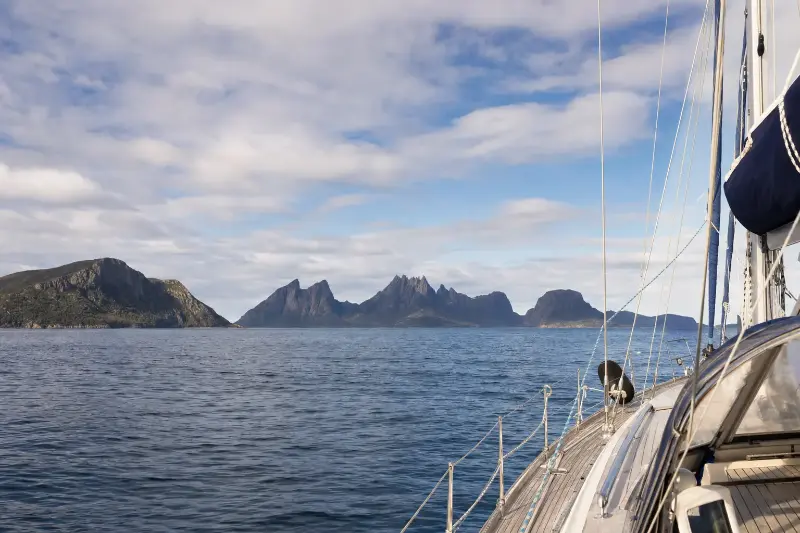
The south coast is the psychological threshold. Around South East Cape and South West Cape, the land feels older and less forgiving. The continental shelf, the Southern Ocean swell and the scarcity of easy refuges all combine to sharpen decision-making. A yacht here should be prepared to wait, and wait well.
Then comes Port Davey and Bathurst Harbour, among the great cruising destinations of the Southern Hemisphere. They sit inside the Tasmanian Wilderness World Heritage Area, a vast protected region recognized for both natural and cultural significance. There are no roads into Port Davey. The water is often dark with tannins washed from buttongrass plains. Mountains rise behind the anchorages. On a calm evening, the place has the silence of a cathedral after closing time.
Farther north, the west coast remains raw. Macquarie Harbour, with its famously narrow entrance known as Hells Gates, has a history bound to convict settlement, mining and timber. It is also a reminder that Tasmania’s coast is not just scenery. It is working water, Aboriginal country, colonial history, environmental conflict and wilderness all layered together.
The Boat and the Mindset
A Tasmania-capable yacht does not need to be huge, but it should be sound, dry and self-sufficient. Reliable ground tackle matters. So do up-to-date charts, redundant navigation, a serviced engine, proper storm gear, a liferaft where appropriate, an EPIRB and crew who can reef early without debate. Communications should be planned, because mobile coverage is not a strategy on remote coasts.
The most important equipment may be psychological. Crews need the temperament to enjoy being pinned down. Waiting for weather is not wasted time in Tasmania; it is part of the voyage. Read, cook, repair, walk where permitted, study the next leg and listen to the forecast again. The island rewards sailors who can turn delay into attention.
A Place That Resists Consumption
Modern travel often sells places as checklists. Tasmania resists that. You do not "do" the west coast in the way one does a museum wing. You enter it on terms set by wind, swell and daylight. You leave when allowed. That imbalance is healthy. It reminds sailors that seamanship is not domination but negotiation.
The beauty of sailing around Tasmania is not merely the beauty of cliffs and beaches, though there is plenty of that. It is the beauty of proportion. A small boat, a large ocean, a crew trying to make good decisions, and an island that remains, despite charts and forecasts, profoundly itself. For sailors who value patience over performance, few voyages in Australian waters are more memorable.