
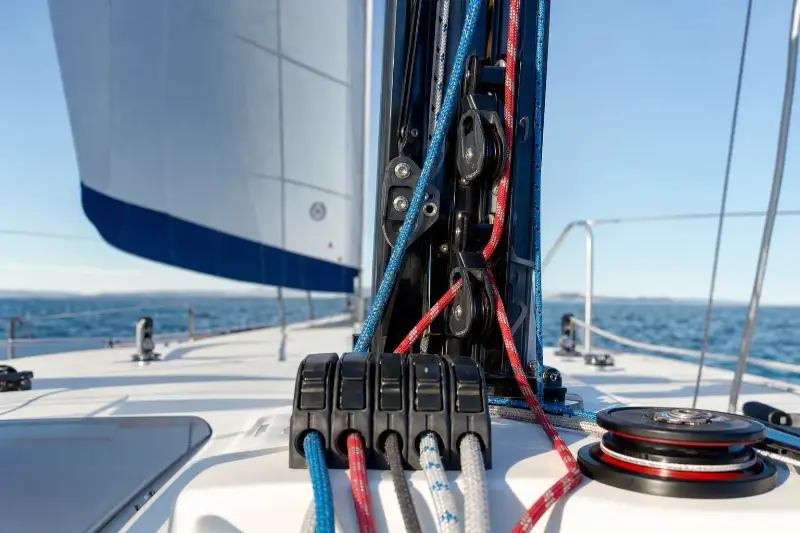
On a sailboat, the poetry is in the canvas, but the grammar is in the rope. Running rigging is the system of lines that lets a crew raise, trim, reef and shape sails. Unlike standing rigging — the fixed wires or rods that hold up the mast — running rigging moves. It is handled, eased, winched, coiled, uncleated and sometimes, in a lively breeze, sworn at.
The subject can look intimidating to new sailors because every line seems to have a name, a purpose and a preferred direction around a winch. But the logic is straightforward. Halyards lift. Sheets trim. Control lines fine-tune. Learn that, and the deck begins to make sense.
What Running Rigging Actually Does
Running rigging turns wind into managed force. A sail is not just a cloth triangle; it is an adjustable airfoil. The lines attached to it determine where it sits, how full it is, how much twist it carries and when it should be reduced for safety. On a modern cruising boat, those lines often lead back to the cockpit through blocks, deck organizers and rope clutches, allowing a small crew to sail without going forward as often.
That convenience is relatively modern. Traditional vessels used hemp, manila and heavy blocks. Today, most everyday cruising lines are double-braid polyester, valued for durability, grip and moderate stretch. Performance boats often use high-modulus polyethylene fibers such as Dyneema, which are lighter and stretch far less. Low stretch matters most in halyards and precise control lines; a stretchy halyard lets the sail sag and lose shape.
Halyards: The Lines That Hoist
A halyard raises a sail. The mainsail has a main halyard, the jib or genoa has a jib halyard, and a spinnaker has a spinnaker halyard. The word is commonly understood as coming from “haul yard,” a reminder of square-rigged sailing, when lines hauled yards — the horizontal spars — aloft or into position.
On a masthead or fractional sloop, the halyard runs from the head of the sail up through a sheave near the masthead, then down inside or outside the mast to the deck. Once the sail is up, halyard tension becomes a sail-shape tool. More tension pulls draft forward and smooths wrinkles along the luff. Too little tension can leave the sail baggy; too much can over-flatten it and strain gear.
For beginners, the key habit is to hoist with the sail luffing into the wind. If the sail is loaded, the friction multiplies quickly. Use the winch only after hand-hoisting as far as possible, and watch for snags: a halyard wrapped around a spreader, radar bracket or lazy jack can damage both sail and rig.
Sheets: The Lines That Trim
Sheets are the working lines sailors touch constantly. They do not hold sails down like bedsheets; they control the angle of the sail to the wind. The mainsheet trims the boom and mainsail. Jib sheets trim the headsail, usually one sheet on each side so the sail can be tacked from port to starboard.
Ease a sheet, and the sail moves outboard. Trim it in, and the sail moves toward the centerline. That simple motion governs speed, heel and balance. Overtrimmed sails often feel powerful but are inefficient, stalling airflow and increasing sideways force. Undertrimmed sails flog and lose drive. The telltales — short yarns or fabric strips on the sail — are often the honest witnesses. When they stream smoothly on both sides of a headsail, the trim is close.
Sheet leads also matter. On a jib, moving the lead car forward increases leech tension and powers the lower part of the sail; moving it aft opens the leech and flattens the foot. Many sailors ignore this adjustment, but it can make a boat calmer and faster, especially as wind builds.
Control Lines: The Fine Print of Speed
Control lines are the quiet specialists. They may not raise or swing a sail, but they determine how efficiently it works. The vang, or kicking strap, pulls down on the boom and controls mainsail leech tension, particularly off the wind when the mainsheet is no longer pulling mostly downward. The outhaul tensions the foot of the mainsail, flattening it in stronger wind and easing it for power in lighter air.
The cunningham, named after American sailor Briggs Cunningham, tensions the luff of the mainsail below the first reef point or near the tack. It is a useful way to move draft forward without grinding harder on the halyard. The traveler moves the mainsheet attachment side to side, controlling boom angle while preserving leech tension. Used well, it reduces heel without dumping all the sail’s shape.
Reefing lines are also part of running rigging. Their job is safety: shortening sail when wind rises. Single-line reefing systems are convenient, but they add friction. Two-line systems — one line for the tack, one for the clew — can be cleaner and more powerful. Either way, a reef should be practiced before it is needed. The worst time to decode a reefing system is in 25 knots of wind and rain.
Rope, Color and Cockpit Order
Good running rigging is not only strong; it is understandable. Color coding matters. A red-flecked line for the main halyard, blue for the jib halyard, green for the vang — the exact scheme is less important than consistency. Labels near clutches help guests and tired crew avoid expensive mistakes.
Diameter is a compromise. A thin high-tech line may be strong enough, but unpleasant to hold and prone to slipping in old clutches. A thicker polyester line may grip well but create more friction through blocks. Hardware and rope must match. A line that is too large for a sheave can wear quickly; one that is too small for a clutch may creep under load.
"Good running rigging is felt before it is admired: it runs cleanly, holds securely and tells the crew what the boat is doing."
Maintenance: Small Checks, Big Consequences
Running rigging lives a hard life: ultraviolet light, salt, chafe, shock loads and wet storage. Inspect high-wear areas first — at shackles, knots, clutches, mast exits and turning blocks. A halyard may look fine in the cockpit but be damaged where it exits the mast. Sheets often chafe where they pass through fairleads or rub against lifelines during long tacks.
Wash salt from lines with fresh water when practical. Dry them before long storage. Replace lines that show broken fibers, flat spots, stiffness, glazing or a soft, hollow feel. Shackles should be moused or secured where failure would be dangerous. Knots should be appropriate: a bowline remains a standard for sheets, though soft shackles and spliced eyes are increasingly common on performance-minded boats.
The Larger Lesson
Running rigging is sometimes treated as a maze of nautical vocabulary. It is better understood as a conversation with the sail plan. Halyards ask the sail to stand. Sheets ask it to work. Control lines ask it to work better.
The best sailors are not merely stronger on the winch; they are more observant. They notice a luff wrinkle, a closed leech, a loaded helm, a line led unfairly. Then they make one small adjustment and watch what changes. That is the art hidden in the rope: not complexity for its own sake, but control, safety and speed made tangible in the hand.