There are island passages that feel like errands, and then there is Madeira to the Azores. On a chart, the route looks seductively simple: leave one Portuguese outpost in the Atlantic, steer northwest, and arrive at another. In practice, it is a compact but serious blue-water passage, long enough to expose weak preparation and short enough to tempt sailors into underestimating it.
The distance depends on the chosen landfall. From Madeira to Santa Maria, the southeastern gateway of the Azores, the passage is roughly 480 nautical miles. To Ponta Delgada on São Miguel it is closer to the mid-500s. To Horta on Faial, the traditional crossroads for Atlantic yachts, it can run near 700 nautical miles. For many cruising boats, that means four to seven days offshore: not an ocean crossing in the grand sense, but very much an ocean passage.
Why this route deserves respect
The Madeira-to-Azores leg sits in a busy piece of meteorological real estate. Madeira lies near the belt of northeast trade winds, while the Azores are shaped by the famous Azores High, a semi-permanent area of high pressure that influences weather across the North Atlantic. Between them, a yacht can encounter useful reaching conditions, frustrating calms, confused seas or the edge effects of passing lows farther north.
That is what makes the passage interesting. It is not a straight-line delivery exercise. It rewards sailors who can read pressure patterns, understand swell direction and resist the false comfort of a single forecast model. A skipper leaving Funchal or Quinta do Lorde with only a quick glance at a phone app is not planning; he or she is hoping.
"The Atlantic is rarely difficult in only one way. It is the combination of wind, swell, fatigue and small decisions that makes a passage serious."
The best season is not a guarantee
Most yachts attempt this route in the warmer months, particularly from late spring through early autumn, when the North Atlantic is generally more settled than in winter. But settled does not mean static. The Azores High can sprawl, shift or weaken. A boat may begin in firm northeast winds near Madeira and later find itself motoring through a glassy ridge of high pressure, or reefing down as a trough sends a sharper breeze across the route.
Summer also brings a different problem: patience. Many crews schedule the Azores as a stop on a larger Atlantic circuit and treat the passage as a calendar item. Offshore sailing is not improved by fixed-date thinking. A 48-hour wait for a cleaner departure window can be worth more than a new sail, a faster hull or a heroic crew.
Route choices: Santa Maria, São Miguel or Faial
Santa Maria is often the logical first landfall if the goal is simply to reach the Azores after leaving Madeira. It is the southeasternmost island in the archipelago and can shorten the offshore leg. Vila do Porto has long served as a practical port of entry for yachts, though crews should check current marina, customs and immigration procedures before departure.
São Miguel, the largest island, draws boats toward Ponta Delgada, where services are broader and onward travel is easier. Faial, farther west, has a near-mythic place in Atlantic cruising culture. Horta’s harbor walls are painted with yacht murals from generations of crews, a sailor’s guest book written in color and salt. But choosing Horta as the first Azorean landfall adds miles and can mean more exposure to changing weather.
The smart choice is not always the romantic one. If a system is developing, Santa Maria may be seamanship. If conditions are settled and the crew is strong, Faial may be worth the extra days. The Atlantic does not care which island appears more charming in the pilot book.
The boat must be ready before the crew feels ready
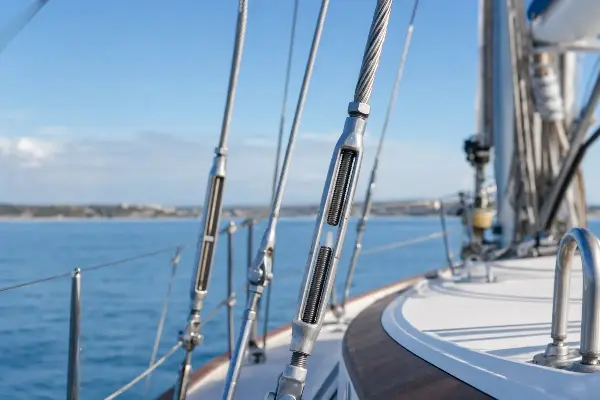
A passage of this length is where deferred maintenance becomes biography. Rigging should be inspected before departure, not admired from the cockpit at sunset. Steering systems deserve particular attention; an autopilot that works in a marina may behave differently after three days of quartering seas. Batteries, alternator output, bilge pumps, navigation lights, jacklines, reefing systems and seacocks all move from checklist items to survival infrastructure offshore.
Fuel planning also matters. The route may look wind-rich, but the middle of the passage can go quiet under high pressure. A yacht should carry enough diesel to motor through calms when necessary, while still preserving a reserve for arrival, battery charging and unexpected delays. Water should be treated the same way. A watermaker is useful; stored water is certainty.
Crew discipline is the hidden equipment
On a four-day passage, fatigue arrives before drama. The first night can be exciting, the second untidy, the third revealing. Watch systems should be simple and respected. Meals should be planned so that cooking does not become a dangerous athletic event. Seasickness medication should be discussed before lines are cast off, not after half the crew has gone silent.
The best offshore crews are rarely the loudest. They reef early, clip on without being reminded and treat sleep as part of the navigation plan. They also talk plainly. If a crew member is cold, anxious or unsure, that information belongs in the open. Silence at sea is not always toughness; sometimes it is poor communication wearing a foul-weather jacket.
Navigation is easy until it is not
Electronic charts and satellite forecasts have made passages like Madeira to the Azores more accessible, but they have not eliminated seamanship. Crews should still keep a written log, plot positions, monitor barometric pressure and maintain a real understanding of where the nearest safe landfall lies. AIS is valuable in the Atlantic, especially around shipping lanes and approaches, but it is not a substitute for a watchkeeper with rested eyes.
Approaching the Azores can be deceptively demanding. Land creates acceleration zones, cloud can hide high ground, and the emotional pull of arrival can encourage carelessness. Many incidents happen near the end of a passage, when everyone has already begun to celebrate. The final 20 miles deserve the same discipline as the first 20.
The reward is proportionate to the effort
What makes this passage memorable is not merely the destination, though the Azores are among the Atlantic’s great rewards: volcanic islands, green slopes, warm harbors and a maritime culture shaped by whalers, fishermen, cable ships and yachts. The deeper satisfaction comes from the scale of the sail itself. Madeira drops astern. The ocean takes over. Days become watches, meals, squalls, stars, sail changes and small repairs. Then, one morning, an island rises from the horizon.
Madeira to the Azores is not a beginner’s coastal hop, nor is it an impossible trial reserved for professional crews. It is something more useful: a passage that tells the truth. About the boat. About the skipper. About the crew. And about whether the people aboard understand that adventure at sea is not the absence of risk, but the careful management of it.