For years, the quiet electrical heart of most cruising yachts was a bank of AGM batteries: sealed, dependable and familiar to almost every marine electrician. Now lithium iron phosphate batteries, usually called LiFePO4, are moving from race boats and high-end cruisers into ordinary cruising yachts. The question is no longer whether lithium works at sea. It does. The better question is whether it works for your yacht, your charging system and your style of cruising.
What AGM batteries do well
AGM stands for absorbed glass mat. Inside the battery, the electrolyte is held in fiberglass mats rather than sloshing freely as in older flooded lead-acid batteries. That makes AGM batteries spill-resistant, low-maintenance and reasonably tolerant of life aboard a yacht. They can be installed in more positions than flooded batteries, they do not require topping up with water, and they have a long record in marine service.
Their great advantage is simplicity. Most alternators, shore-power chargers, wind generators and solar regulators can be set up for AGM without drama. If an AGM battery fails in a cruising port, a replacement is often easy to find. For sailors who mostly spend weekends aboard, motor between marinas, or rarely discharge their house bank deeply, AGM remains a sensible choice.
Where AGM falls behind
The weakness of AGM is usable capacity. A 200-amp-hour AGM bank should not routinely be drawn down to 20 percent remaining charge if long life is the goal. Many owners treat roughly 50 percent depth of discharge as a practical limit. In plain English, a 200-amp-hour AGM bank often offers about 100 amp-hours of comfortable use.
AGM batteries also dislike being left partially charged. This is a common cruising problem. A yacht may motor for an hour, run the refrigerator all day, then rely on solar that never quite brings the bank back to full. Over time, lead-acid batteries can suffer sulfation, reducing capacity. AGM can be excellent, but it rewards owners who regularly recharge fully.
Why lithium has changed yacht electrics
Most marine lithium upgrades use LiFePO4 chemistry, not the more volatile lithium-ion chemistries associated with phones or some electric vehicles. LiFePO4 is widely valued for thermal stability, long cycle life and high usable capacity. A properly installed lithium house bank can often be discharged to 80 percent depth of discharge, sometimes more depending on manufacturer guidance. That means a 200-amp-hour lithium bank may deliver far more usable energy than a similarly rated AGM bank.
Lithium also charges faster. Lead-acid batteries accept high current when depleted but slow down as they approach full charge. Lithium batteries can accept strong charging currents through much of their charge range, provided the system is designed for it. For a yacht with limited engine hours, this matters. Less time motoring to charge batteries means less noise, less fuel and a more pleasant anchorage.
The weight argument is real
A typical 100-amp-hour AGM battery may weigh roughly 60 to 70 pounds. A comparable 100-amp-hour LiFePO4 battery often weighs around 25 to 35 pounds. Exact numbers vary by brand, but the pattern is clear. On a performance cruiser, a catamaran or any yacht sensitive to weight in the ends, that saving is not trivial. Removing 150 or 200 pounds from a battery compartment can improve trim and make room for other gear.
The hidden cost of lithium
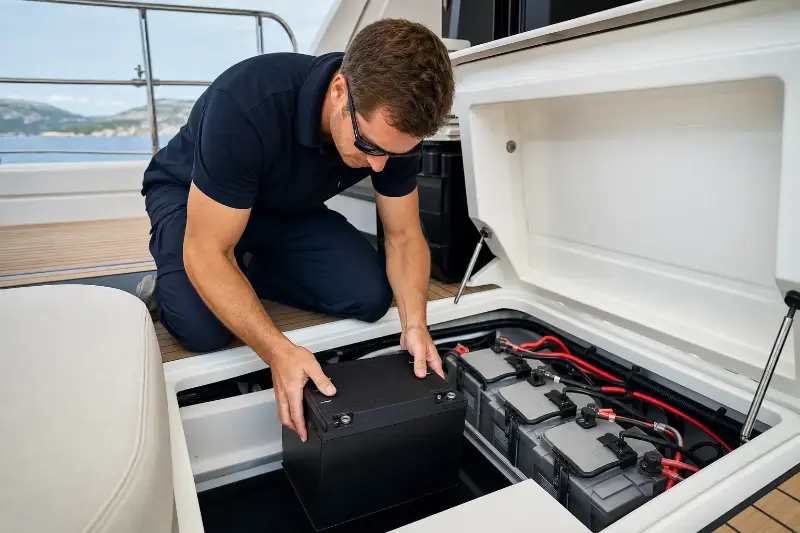
The sticker price of lithium has fallen, but it is still usually higher than AGM. Yet the battery itself is only part of the bill. A proper lithium conversion may require a battery management system, upgraded fusing, appropriate chargers, alternator protection, new monitoring and careful wiring. Many modern drop-in LiFePO4 batteries include an internal battery management system, but that does not mean the rest of the yacht is automatically ready.
The alternator is a particular concern. Lithium batteries can demand high current for long periods. A conventional alternator on a marine diesel may overheat if asked to feed a large lithium bank without regulation or current limiting. Sensible installations often use an external regulator, a DC-to-DC charger or other protection. This is not a place to improvise.
Safety: less drama, more discipline
LiFePO4 is considered one of the safer lithium chemistries, but safe does not mean casual. Batteries should be installed according to manufacturer instructions and applicable marine electrical standards. Proper overcurrent protection, secure mounting, adequate cable sizing and clean terminations are basic seamanship. A battery that can deliver large current very quickly deserves respect.
Cold-weather charging is another important fact. Many LiFePO4 batteries should not be charged below freezing unless they have built-in heating or low-temperature charge protection. AGM does not have the same limitation, which may matter for high-latitude sailors or winter liveaboards.
So which is better for cruising?
If your yacht lives at a dock, sails on weekends and has modest electrical loads, AGM may be the better value. It is proven, available and relatively forgiving. If your biggest loads are lights, instruments, a VHF radio and an occasional freshwater pump, lithium may be overkill.
If you cruise off-grid, run a refrigerator, freezer, autopilot, watermaker, induction cooking or Starlink, lithium becomes much more persuasive. The ability to use more of the bank, recharge faster and save weight can change the daily rhythm aboard. It can turn electrical management from a constant worry into a background system.
"The best battery is not the one with the newest chemistry. It is the one that matches the boat, the charging sources and the skipper's habits."
A practical verdict
AGM is the conservative choice: cheaper up front, easier to replace and well understood. Lithium is the strategic choice: more expensive to install properly, but lighter, longer-lived and better suited to energy-hungry cruising. The mistake is judging either technology by the battery label alone.
Before switching, make an energy budget. Add up daily amp-hour use. Look at solar output, alternator capacity and shore-power charging. Inspect cable runs and ventilation. Ask whether your cruising is marina-based or anchored for days. On yachts, as in navigation, context is everything.
For many owners, AGM remains perfectly rational. For serious cruisers building a modern electrical system, LiFePO4 is increasingly hard to ignore. The future of yacht power is not simply lithium; it is better-designed systems. Lithium merely exposes whether the rest of the boat is ready.