
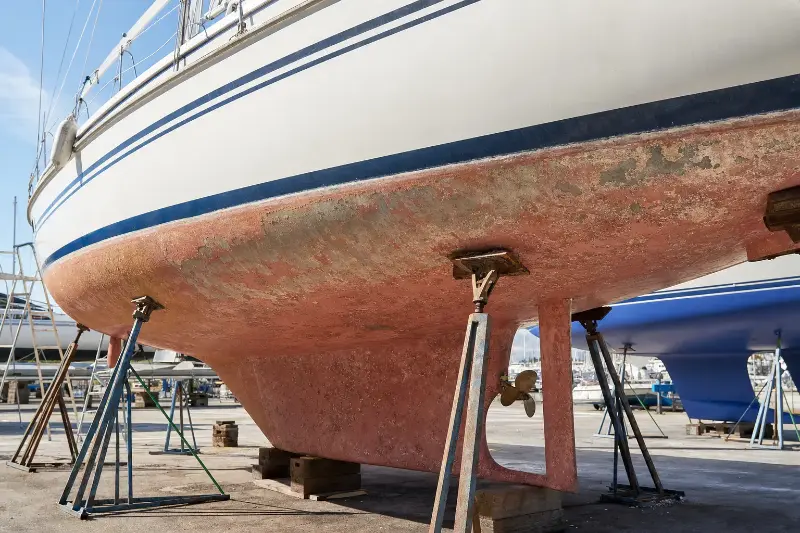
Glass-reinforced plastic, usually called GRP in Britain and much of Europe and fiberglass in the United States, changed yachting more than almost any material of the 20th century. It made small cruisers cheaper, racing hulls lighter and boat ownership less dependent on the annual rituals of wooden planks, fastenings and seams. But GRP is not magic. It is a composite: glass fibres carrying load, resin holding them together, and often a gelcoat forming the glossy outer skin. Like every composite, it fails in particular ways.
Two words tend to worry owners most: osmosis and delamination. They are often spoken of as if they were the same disease. They are not. Osmosis is usually a chemical and moisture problem in or near the outer laminate. Delamination is a structural separation inside the laminate or between skins and core. One can be ugly and expensive. The other can be genuinely dangerous. Understanding the difference is the beginning of good judgment.
What a GRP hull really is
A typical older production yacht hull is made from layers of glass mat or woven cloth saturated with polyester resin, with a pigmented gelcoat sprayed into the mould first. Later and higher-specification boats may use vinylester resin, epoxy resin, stitched fabrics, vacuum infusion or sandwich construction with balsa, foam or other cores. These choices matter. Vinylester and epoxy generally resist water penetration better than basic polyester, and controlled resin-to-glass ratios can make a laminate stronger and less void-prone.
But the basic idea remains simple. The glass provides tensile strength; the resin locks the fibres into shape and transfers load; the gelcoat protects the surface and provides finish. If water, impact or poor workmanship defeats any part of that system, trouble can start.
Osmosis: the blister everyone fears
Osmosis in GRP hulls is commonly seen as blistering below the waterline. Water molecules slowly pass through the gelcoat and react with soluble materials inside the laminate, including byproducts from resin curing. The resulting fluid can be acidic and more concentrated than seawater. It attracts more moisture, pressure builds, and a blister appears.
The classic sign is a raised bubble under the gelcoat. When opened, it may smell sharp, like vinegar. That smell is not proof on its own, but it is a familiar clue. Small, scattered blisters on an old hull may be more cosmetic than catastrophic. Large fields of deep blisters, weeping laminate or high moisture readings over broad areas deserve much more attention.
“A blister is not a verdict. It is evidence.”
That distinction matters. Many GRP yachts with some osmotic blistering have sailed safely for decades. Osmosis rarely sinks a boat overnight. The real questions are: how deep is it, how widespread is it, how wet is the laminate, and is the owner prepared for the cost and time of proper repair?
How surveyors assess osmosis
A competent survey normally combines visual inspection, percussion sounding and moisture meter readings. Moisture meters can be useful, but they are not truth machines. Antifouling residues, metal fittings, thick laminates, temperature and recent hauling can all distort readings. A boat lifted yesterday after months afloat may read very differently from one that has dried ashore for a season.
Good surveyors look for patterns. Is moisture concentrated near through-hulls, keel areas or old repairs? Are blisters shallow under the gelcoat, or do they extend into laminate? Has the hull been peeled before? Is there evidence of barrier coating? The answer is seldom a single number on a meter. It is a reasoned conclusion from several clues.
Delamination: when layers stop working together
Delamination is more serious because a composite only works properly when its layers act as one. Delamination can occur after impact, from flexing, from poor original bonding, from water intrusion into a cored structure, or from badly executed repairs. In a solid laminate hull, it may appear as a dull sound when tapped, visible cracking, a soft area or a bulge. In a sandwich deck or hull, water can rot balsa core or weaken foam bonds, leaving the skins unsupported.
On sailboats, pay particular attention around chainplates, stanchion bases, keel floors, rudder stocks, engine beds and areas that have taken groundings. These are places where loads are concentrated. A small cosmetic crack near a locker lid is one thing. Movement around a keel matrix after a hard grounding is another.
Repairing osmosis properly
Osmosis repair ranges from local blister treatment to a full underwater hull peel. For isolated blisters, a yard may grind them open, wash repeatedly, allow drying, fill with epoxy filler, fair the surface and apply epoxy primer before antifouling. For widespread cases, the gelcoat may be mechanically peeled below the waterline, the laminate washed to remove soluble residues, dried over weeks or months, then rebuilt with epoxy fairing compounds and an epoxy barrier system.
The drying stage is where impatient repairs fail. Sealing moisture inside a laminate is like painting over damp plaster: it may look solved at launch, but the chemistry has not disappeared. Heated sheds, controlled humidity and repeated measurements can help, though they add cost.
Epoxy barrier coatings are widely used because epoxy is less permeable to water than polyester gelcoat. They are not a cure for bad laminate, but they can be an effective protective system when applied to a clean, dry, properly prepared hull.
Repairing delamination
Delamination repair is more structural and more localised, though sometimes larger in scope. The damaged laminate is usually cut back to sound material, often with a tapered or scarfed edge so new glass can distribute loads smoothly. New glass fabric is laid with epoxy or suitable resin, consolidated, cured, faired and coated. In cored construction, wet or crushed core must be removed and replaced; simply injecting resin into rotten balsa is rarely a lasting answer.
The repair should match the structure, not merely the appearance. Fibre orientation, laminate thickness, bonding area and load paths all matter. This is why serious delamination near keels, rudders, chainplates or bulkheads belongs in the hands of an experienced composite repairer or naval architect, not a weekend experiment with a tin of filler.
When to worry, and when not to
A 35-year-old cruiser with a few shallow blisters is not automatically a bad boat. Indeed, some older hand-laid hulls were built heavily and can tolerate blemishes well. Conversely, a newer lightweight hull with hidden impact damage or a saturated core may present greater risk despite a glossy finish. Age alone is a poor guide. Condition, construction and use tell the real story.
For buyers, the practical approach is calm scepticism. Budget for a lift-out survey. Ask for repair records. Look for consistency between the seller’s account and the physical evidence. If a hull has had osmosis treatment, find out when, by whom and what system was used. A documented professional repair may be reassuring; a freshly painted bottom with no paperwork should invite questions.
The bottom line
GRP hulls earned their dominance because they are durable, repairable and comparatively low maintenance. But they are not maintenance-free. Osmosis is often a management and cost issue. Delamination is a structural issue until proved otherwise. The wise owner does not panic at every blister or ignore every dull tap. He or she gathers evidence, understands the loads, and repairs the boat in a way that respects the material.
In boatyards, as at sea, judgment is everything. The hull is not merely the shell around the adventure. It is the structure that makes the adventure possible.