French Polynesia is often sold as a postcard: a thatched roof over clear water, a hibiscus tucked behind an ear, a mountain rising like a green cathedral from the Pacific. But from the deck of a sailboat, the Society Islands become something more interesting than paradise. They become a lesson in weather, distance, reef navigation, patience and restraint.
The chain is not large by ocean standards, but it feels immense. Tahiti, Moorea, Huahine, Raiatea, Taha’a and Bora Bora sit in the central South Pacific, part of French Polynesia, an overseas collectivity of France spread across an area of ocean roughly the size of Western Europe. The islands themselves are tiny marks on a vast blue map. To sail here is to understand that the main character is not land. It is water.
Start in Tahiti, but do not linger too long
Most sailing journeys begin in Tahiti, because nearly everyone arrives through Faa’a International Airport, just outside Papeete. The capital has traffic, supermarkets, repair shops, chandlers and bureaucracy — all the unromantic infrastructure that makes a romantic voyage possible. For charter crews, it is the place to provision seriously: fresh fruit, baguettes, tinned goods, reef-safe sunscreen, spare filters and the quiet confidence that comes from having checked the weather twice.
Tahiti is worth time on land. The island’s interior is mountainous and wet, carved by valleys and waterfalls. Its coastline carries the complexity of a modern Pacific society: French administration, Polynesian culture, Chinese-Tahitian commerce, surf culture, cruise ships, churches and food trucks. But as a sailing base, Tahiti is often a threshold. The better rhythm begins once the sails are up and Moorea appears across the Sea of the Moon, only about 10 nautical miles away.
Moorea: the first reward
Moorea is close enough to Tahiti to feel accessible and dramatic enough to feel like an arrival. Its two famous bays, Cook’s Bay and Opunohu Bay, cut deep into the north coast, framed by steep ridges. Contrary to a common assumption, Cook’s Bay was not named because Captain James Cook anchored there; he visited Moorea in the 1770s but anchored in nearby Opunohu Bay. The name came later, as names often do in the Pacific, through layers of memory and outside interpretation.
For sailors, Moorea offers relatively protected anchorages, clear water and an immediate education in lagoon discipline. Coral is not scenery to be parked on. Anchors should be set in sand patches, with care taken to keep chain off living coral. This is both environmental ethics and seamanship. A damaged reef is not just ugly; it is a weakened breakwater, nursery and cultural inheritance.
"The first rule of sailing French Polynesia is simple: the lagoon is generous, but it is not forgiving."
Raiatea and Taha’a: the sailor’s heart of the Societies
Many experienced charter sailors begin not in Tahiti but in Raiatea, the main yacht-charter hub of the Leeward Islands. Raiatea shares a lagoon with Taha’a, and the two islands are enclosed by a broad barrier reef with several navigable passes. This makes the area unusually rewarding: you can sail meaningful daily legs while remaining inside relatively protected water.
Raiatea also carries deep cultural importance. The marae of Taputapuātea, on the island’s southeast coast, is a UNESCO World Heritage Site and one of the most significant ceremonial and political centers in eastern Polynesia. It connects the Society Islands to the larger story of Polynesian voyaging — a history of navigation by stars, swells, birds, clouds and disciplined observation, long before GPS made sailors lazy and safer at the same time.
Taha’a, by contrast, is quieter and fragrant. It is often called the Vanilla Island because much of French Polynesia’s vanilla is grown there. A slow sail around Taha’a, with stops near coral gardens and motus, is one of the great pleasures of the region. The pace resists hurry. The best days here are not packed; they are edited.
Bora Bora: famous, crowded, still astonishing
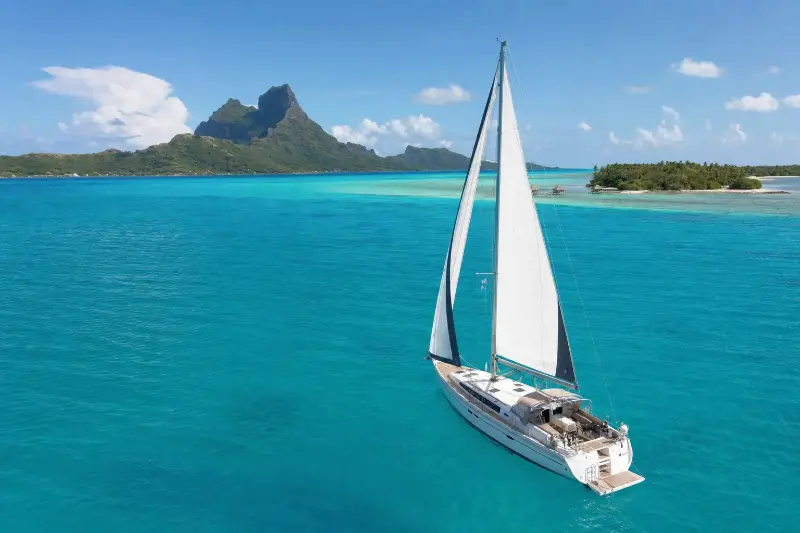
Bora Bora has suffered the fate of all world-famous places: it must compete with its own image. The name has been used to sell honeymoons, luxury resorts and fantasies of escape for decades. Yet the view from a boat remains startling. Mount Otemanu rises from the center of the island, dark and jagged, while the lagoon shifts from cobalt to turquoise to improbable shades of blue that seem digitally enhanced, even when they are not.
There is only one main navigable pass into Bora Bora’s lagoon, Teavanui Pass, on the west side. That fact matters. Passes in French Polynesia can have strong currents, especially when swell, wind and tide oppose each other. Good sailors time entrances, read local guidance and do not treat a chartplotter as an oracle. Electronic charts are useful; eyeball navigation is still essential in coral water.
Bora Bora’s lagoon is more regulated than some first-time visitors expect, and mooring rules can change. Skippers should check current local requirements before arrival and use designated moorings where required. This is not bureaucratic fussiness. It is the consequence of heavy visitation in a fragile place.
Huahine: the island people remember
If Bora Bora is the celebrity, Huahine is the person you hope to sit next to at dinner. It is lush, less polished and deeply appealing. The island is actually two islands, Huahine Nui and Huahine Iti, joined by a bridge. Its lagoon offers anchorages, archaeological sites and a sense of lived-in beauty. Many sailors leave calling it their favorite stop.
Huahine rewards those who step ashore without a checklist. Rent a bicycle or a small car. Visit the village of Fare. Look for the ancient fish traps near Maeva, where stone structures in the water speak to older systems of abundance and management. In the late afternoon, return to the boat, rinse the salt off, and watch the mountains lose detail in the falling light.
When to sail and what to expect
The main cruising season generally runs from May to October, during the drier, cooler period, when southeast trade winds are more established. That does not mean calm. Trades can blow briskly, and squalls still happen. The warmer, wetter season from roughly November to April brings higher humidity and a greater cyclone risk, though French Polynesia lies on the eastern edge of the South Pacific cyclone belt and risk varies by year.
Most inter-island passages in the Societies are manageable for competent coastal sailors, but they are still ocean passages. Swell can be uncomfortable. Reefs demand attention. Night entrances are a bad idea unless you have exceptional local knowledge. The old advice remains sound: arrive with the sun high enough to read the water.
The romance is real, but it is earned
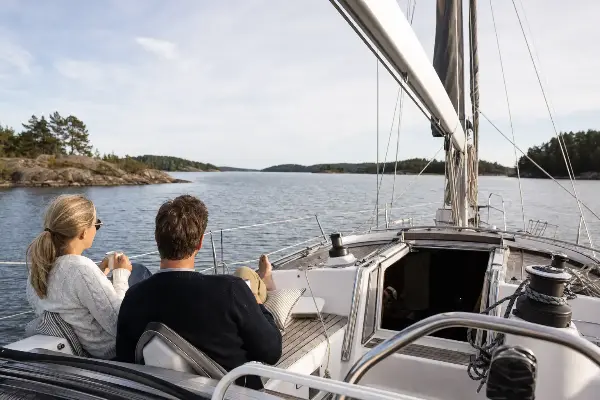
French Polynesia is often described as effortless romance. A sailor knows better. The romance is in the work: reefing before the squall, making coffee at anchor, sharing a cockpit silence after a clean passage, choosing not to rush to the next island. For couples, it is a revealing place. Boats compress personalities. They expose generosity, anxiety, competence and selfishness quickly.
That may be the most useful dating tip hidden inside a sailing guide: choose someone who behaves well in a crosswind, who can be quiet without being bored, who treats local people with respect and who understands that paradise is not a backdrop for the self. It is a place with rules, history and limits.
Seen by sail, Tahiti, Bora Bora and the Society Islands are not merely beautiful. They are instructive. They teach scale, humility and attention. The Pacific does not care about your itinerary. But if you listen to the wind, enter the passes carefully and leave the coral untouched, it may give you something better than a vacation: the feeling of having traveled properly.