Catamarans have changed the way many sailors think about cruising. Their shallow draft opens anchorages that deeper monohulls must pass by. Their wide beam gives families, charter groups and liveaboards room to breathe. And on long downwind legs, a well-handled cruising cat can make the miles feel less like punishment and more like travel.
But not every beautiful sailing ground is ideal for a multihull. Catamarans like space in marinas, protected anchorages, reliable weather windows and routes where their speed and stability matter. The best catamaran passages are not simply postcard-pretty. They are practical, forgiving and rich enough to reward slow travel.
The British Virgin Islands: The Classic First Catamaran Route
The British Virgin Islands remain one of the world’s most forgiving places to charter a catamaran. The islands are close together, the Sir Francis Drake Channel is generally sheltered, and most legs are short enough to leave time for swimming, snorkeling and lunch under a bimini.
A typical route begins on Tortola, then runs to Norman Island, Cooper Island, Virgin Gorda, Anegada and Jost Van Dyke before returning. Anegada, a low coral island, is the one stop that asks for more attention because reefs and shallow water make careful navigation essential. For catamarans, that same shallow water is part of the appeal. You can often anchor comfortably where deeper boats cannot.
The BVI is popular for a reason: it gives new multihull crews confidence without making the sea feel tame.
The Exumas, Bahamas: Shallow-Draft Paradise
If there is a cruising ground designed by nature for catamarans, it may be the Exumas. This Bahamian chain is famous for luminous banks, sandbars, marine life and water so shallow that draft becomes destiny. A catamaran drawing four feet or less can explore areas unavailable to many keelboats.
Most itineraries begin near Nassau or in the northern Exumas and move through Highbourne Cay, Warderick Wells, Staniel Cay and farther south if weather and time allow. The Exuma Cays Land and Sea Park, established in 1958, is one of the oldest marine protected areas in the Caribbean region and remains a highlight for responsible cruisers.
The caution is that the Bahamas are not the same as the sheltered BVI. Cold fronts can bring strong winds, and cuts between the banks and Exuma Sound can become rough when wind and tide oppose each other. Good timing matters.
Croatia’s Dalmatian Coast: Islands, Harbors and History
Croatia has become a Mediterranean charter powerhouse because it offers a rare mix: hundreds of islands, short passages, reliable summer tourism infrastructure and old stone towns that feel built for arrivals by sea. A catamaran route from Split might include Brač, Hvar, Vis, Korčula and the Pakleni Islands.
For multihulls, the appeal is space on deck and comfort at anchor, especially in coves where evenings can be calm and social. The challenge is berthing. Mediterranean marinas often charge by length and sometimes by beam, and prime town quays fill quickly in high season. The bora, a cold northeasterly wind, and the jugo, a southeasterly, are well-known regional weather patterns that deserve respect.
Greece: Cyclades Drama or Saronic Ease
Greece offers two very different catamaran moods. The Cyclades are dramatic: white villages, blue-domed churches, dry hills, fast passages and wind with a reputation. The Meltemi, a strong northerly that commonly blows in summer, especially July and August, can turn an ambitious holiday plan into a lesson in humility.
For less experienced catamaran crews, the Saronic Gulf is often the wiser route. From Athens, sailors can reach Aegina, Poros, Hydra and Spetses with more protected waters and shorter legs. Hydra’s harbor is famously crowded and may not suit every catamaran, but the region as a whole gives charterers a gentler introduction to Greek cruising.
In Greece, the best skipper is not the one who sees the most islands, but the one who knows when to skip one.
Belize: Reefs, Cayes and Careful Navigation
Belize is a superb catamaran destination for crews who value reefs, fishing villages and a feeling of being slightly off the mainstream charter circuit. The country sits along the Mesoamerican Barrier Reef system, widely described as the second-largest barrier reef system in the world after Australia’s Great Barrier Reef.
Routes often start near Placencia and move through the cayes, with stops such as South Water Caye, Tobacco Caye or the Pelican Cayes, depending on permits, conditions and local guidance. Catamarans do well here because of their shallow draft and stable platforms for snorkeling and diving. But this is not a place for casual eyeball navigation alone. Coral heads, reefs and protected zones require current charts, local briefings and restraint.
The Society Islands, French Polynesia: The Dream Route
French Polynesia is where catamaran cruising begins to feel cinematic. A favored route runs among Raiatea, Taha’a, Bora Bora and Huahine in the Society Islands. Raiatea is an important charter base and a cultural heartland; nearby Taha’a shares the same lagoon and is known for vanilla cultivation. Bora Bora, for all its fame, still earns its reputation when seen from a quiet anchorage at sunset.
The distances are longer than in the BVI, and the Pacific is never a swimming pool. But lagoons, passes and trade-wind passages suit capable catamarans well. This is also a route where the boat’s living space matters. In humid tropics, shade, ventilation and a large cockpit can change the entire quality of a voyage.
Seychelles: Granite Islands and Indian Ocean Color
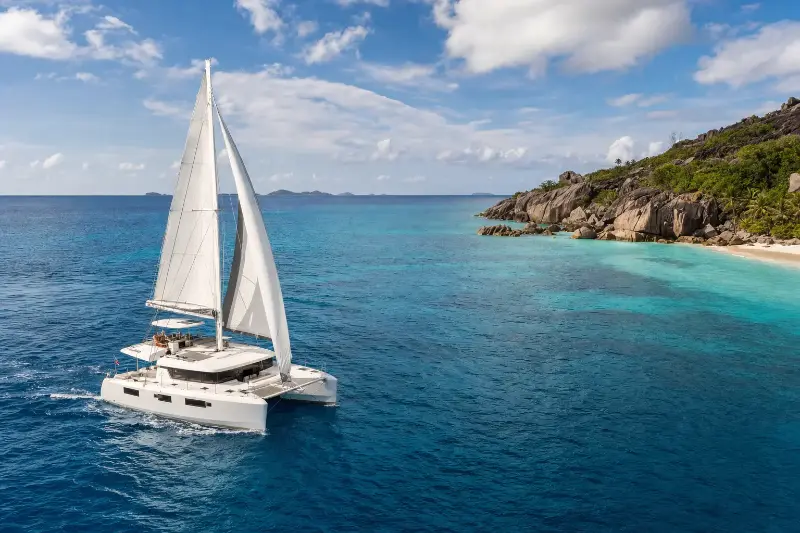
The inner Seychelles, including Mahé, Praslin and La Digue, offer one of the most distinctive sailing landscapes on earth. Instead of only coral atolls, sailors find granite boulders, green hills and beaches that seem almost staged. The sailing distances can be manageable, making the area attractive for catamarans and crews who want a luxurious but nature-heavy itinerary.
Seasonal planning is essential. The southeast trade winds and northwest monsoon shape conditions, and some anchorages become uncomfortable depending on swell direction. Still, a catamaran’s stability at anchor and generous deck space make it an excellent platform for this warm, visually extravagant cruising ground.
What Makes a Route Right for a Catamaran?
The best catamaran routes usually share several traits: anchorages with enough swinging room, shallow areas worth exploring, steady breezes, and marinas or mooring fields that can handle beam. Catamarans are comfortable, but they are not magic. Their high windage can make docking harder. Their wide stance can raise marina costs. And while many are fast off the wind, they may not point as closely into the breeze as a performance monohull.
That is why route choice matters. A great catamaran itinerary uses the boat’s strengths instead of fighting its compromises. It favors reaching and running over endless upwind slogs. It leaves time for weather. It treats the anchorage not as a parking lot, but as the main event.
The Bottom Line
For first-timers, start with the British Virgin Islands or the Saronic Gulf. For shallow-water beauty, choose the Exumas or Belize. For cultural density, Croatia and Greece are hard to beat. For once-in-a-lifetime scale, French Polynesia and the Seychelles sit near the top of the list.
The finest catamaran routes are not measured only in nautical miles. They are measured in mornings when the boat barely moves, evenings when the cockpit becomes a dining room, and passages that feel steady enough to let everyone look up from the chart and actually see the world.