
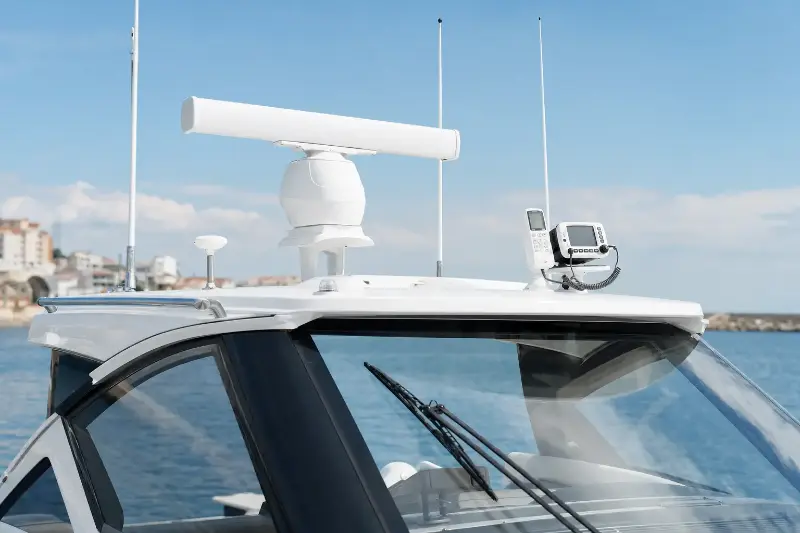
There is a particular kind of silence that settles over a boat in fog. The shoreline disappears. The engine note sounds louder. Every buoy, ferry and fishing skiff seems suddenly theoretical. This is the moment when modern electronics stop looking like expensive accessories and start looking like what they are: safety equipment.
For buyers of sailboats and powerboats, three systems deserve special attention: radar, AIS and VHF radio. They are often discussed together, and they do overlap. But they are not interchangeable. Each answers a different question. Radar asks, “What is physically out there?” AIS asks, “Who is broadcasting out there?” VHF asks, “How do I talk to them or call for help?”
A smart buyer does not simply ask whether a boat has these tools. The better question is whether they are modern, correctly installed and understood by the crew.
Radar: The Instrument That Does Not Need Cooperation
Radar remains the most independent of the three. It sends out radio waves and reads what bounces back. A cliff, rain squall, steel ship, buoy or small craft may appear on the display whether or not it is transmitting anything. That matters because many hazards do not carry AIS, and some small boats have no electronics turned on at all.
Today’s recreational marine radars are commonly solid-state units, often marketed as broadband, pulse-compression or Doppler radar. Compared with older magnetron radars, many draw less power, warm up quickly and can be better at short-range target detection. Doppler features, available on some models, can help distinguish targets moving toward the boat from those moving away. That is genuinely useful when a harbor approach is crowded and visibility is poor.
But radar is not magic. Fiberglass boats can be weak targets. Sea clutter can obscure small objects. A poorly mounted dome, especially one shaded by a mast or too low above the water, can leave blind sectors or reduce range. On a sailboat, placement is a compromise: high enough to see, low enough to avoid excessive weight aloft and practical enough for wiring and maintenance.
“Radar is not a substitute for keeping watch; it is a way of making the watch more informed.”
Buyers should ask whether the radar integrates with the chart plotter, whether target tracking is enabled, and whether the crew knows how to tune gain, sea clutter and rain clutter. The best radar on the market is of limited value if its owner only turns it on when already frightened.
AIS: The Name Tag of the Modern Seaway
AIS, or Automatic Identification System, is one of the most important advances in small-boat safety in the last generation. It transmits and receives data over VHF frequencies, including a vessel’s identity, position, course, speed and sometimes destination. Commercial ships subject to international rules generally carry Class A AIS. Many yachts carry Class B, which transmits less frequently and at lower power, though newer Class B SOTDMA units offer improved performance over older CSTDMA units.
The appeal is obvious. Instead of seeing a vague blob on a screen, a skipper may see the ship’s name, speed and closest point of approach. In busy waters, that can reduce anxiety and improve decisions. AIS also makes your own boat more visible to ships, ferries and other equipped vessels.
Yet AIS has a dangerous social weakness: it depends on participation. A floating log, an unlit day boat, a kayak, a buoy without a transmitter or a vessel with AIS switched off will not appear. Some military, law enforcement or commercial vessels may limit what they transmit. Fishing boats do not always behave predictably, even when displayed neatly on a screen.
For buyers, the first distinction is receive-only versus transceiver. A receive-only AIS lets you see others but does not help them see you. A transceiver broadcasts your position, which is usually the wiser choice for cruising, offshore passages and nighttime sailing. The system should have a properly registered MMSI number and should be connected to a good antenna. Some installations use a splitter to share the main VHF antenna, while others use a dedicated AIS antenna. Either can work, but quality matters.
VHF: The Old Tool That Still Saves Lives
VHF radio may seem plain beside colorful screens, but it remains central to marine safety. It is direct, widely used and monitored in many coastal areas. Channel 16 is the international calling and distress frequency for voice communications. In the United States, the Coast Guard’s Rescue 21 system provides extensive VHF distress monitoring along much of the coast, though coverage is not universal everywhere and depends on range, antenna height and local conditions.
The key modern feature is DSC, or Digital Selective Calling. A fixed-mount VHF with DSC and a programmed MMSI can send a digital distress alert at the press of a red button, including the vessel’s identity and, if connected to GPS, its position. That is a major improvement over a panicked voice call from a crew that may not know exact coordinates.
When inspecting a boat, a buyer should check whether the VHF has DSC, whether the MMSI is correctly programmed, whether GPS data is connected, and whether the antenna and coaxial cable are in good condition. Antennas fail. Connectors corrode. A radio that powers on at the dock may still have poor range because of a tired cable hidden behind a liner.
A handheld VHF is also worth carrying, especially in the cockpit or ditch bag. It will not match the range of a fixed radio with a masthead antenna, but it can be invaluable after a power failure, dismasting or abandon-ship emergency.
Integration Is Helpful, But It Can Also Hide Problems
The modern helm is increasingly a network: radar overlay on charts, AIS targets on the plotter, VHF radios receiving GPS data, alarms calculating closest point of approach. This integration can be excellent. It can also create a false sense of certainty.
A chart plotter is only as good as its charts, sensors and setup. AIS targets can be delayed. Radar images require interpretation. Alarms can be set so sensitively that crews ignore them, or so loosely that they miss what matters. Buyers should ask for a live demonstration underway, not just a glowing screen at the dock.
Compatibility is another issue. Marine electronics often communicate through NMEA 0183 or NMEA 2000 networks, plus manufacturer-specific systems. Older gear may not share data cleanly with newer equipment. A bargain boat with a “full electronics package” may, after survey, need a substantial refit to make its safety systems talk to one another.
What Should a Buyer Prioritize?
For coastal cruising, a fixed VHF with DSC, a registered MMSI and a reliable antenna should be considered essential. AIS receive capability is highly desirable; an AIS transceiver is better. Radar becomes more important for night sailing, fog-prone regions, shipping lanes, offshore passages and any plan that includes tight landfalls in poor visibility.
For offshore work, redundancy matters. That may mean a backup handheld VHF, independent GPS sources, an EPIRB or PLB, paper or offline navigation options, and enough battery capacity to run electronics during a long emergency. Safety equipment is a system, not a shopping list.
My view is that buyers often overvalue cosmetic upgrades and undervalue electronics installation quality. A new display at the helm is seductive. A properly crimped connector, dry antenna lead and correctly configured distress radio are less glamorous. But when the weather closes in, the boat will not care what looked impressive in the sales photos.
The Human Factor
The final piece is training. Radar, AIS and VHF are not safety equipment in the same way a cushion is safety equipment. They require judgment. Crews should practice making a DSC test call where permitted, interpreting AIS closest-point data, using radar ranges, and hailing another vessel clearly and briefly.
The best electronics reduce uncertainty; they do not remove responsibility. A prudent buyer should see them not as gadgets, but as instruments of seamanship. In fog, at night, or in a crowded shipping lane, that distinction can be the difference between anxiety and control.