A keel is easy to overlook because, in ordinary use, it is mostly invisible. Yet it is one of the most consequential parts of a sailboat. It gives the hull lateral resistance, so the boat can sail upwind rather than simply slide sideways. If it carries ballast, it also lowers the center of gravity and helps the boat stand up to the force of the sails.
In plain language, the keel is the boat’s handshake with the water. Its shape affects speed, pointing ability, motion at sea, draft, grounding risk, maintenance and even resale value. No keel is best at everything. The right choice depends on where you sail, how you sail and how much inconvenience you are willing to accept in exchange for performance or shallow-water freedom.
"Every keel is a compromise, but some compromises suit a sailor better than others."
Fin Keel: The Modern All-Rounder
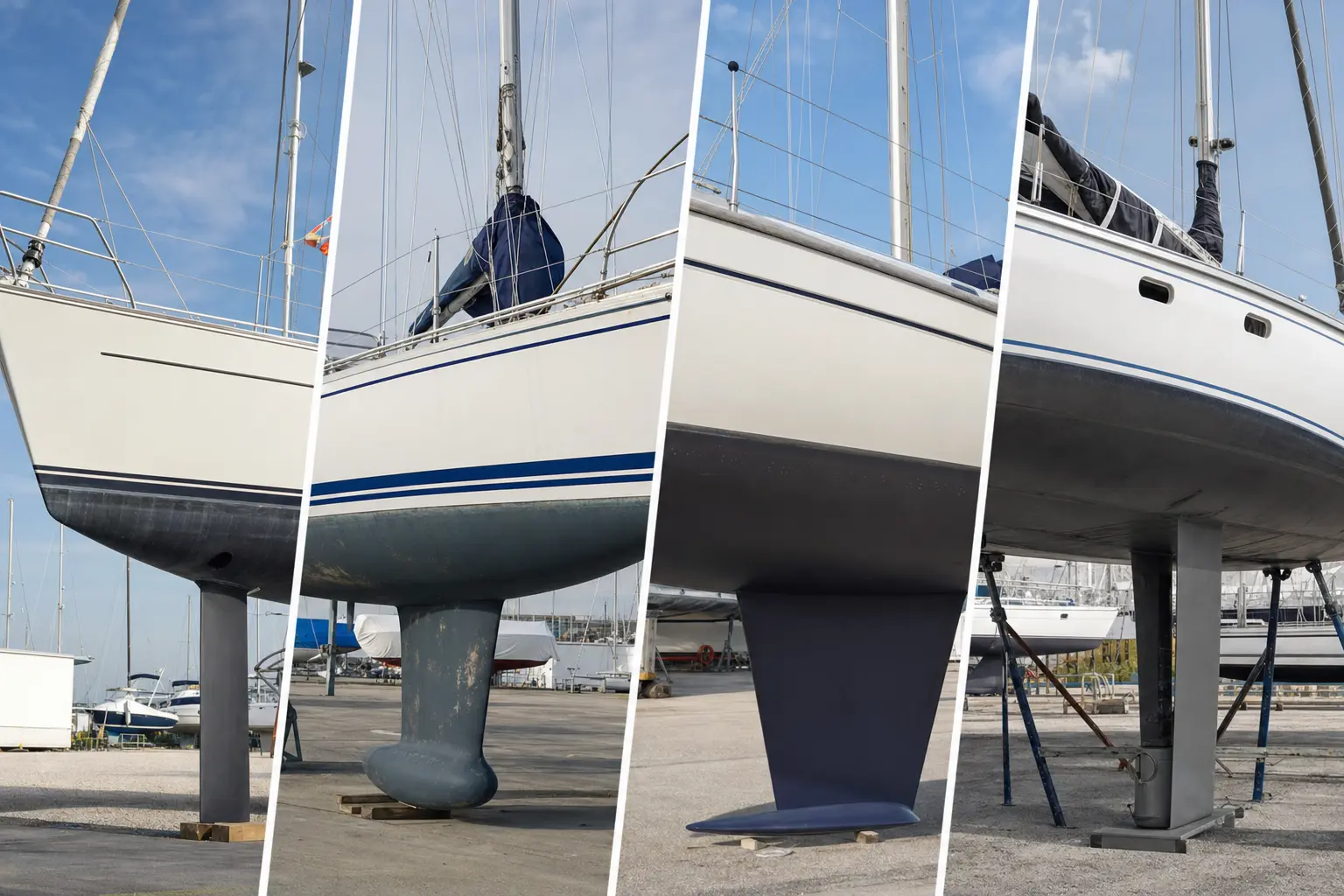
The fin keel is the most common keel on contemporary cruising and racing sailboats. It is relatively narrow fore and aft, deep compared with the hull, and shaped much like an underwater wing. Because it produces lift efficiently, a well-designed fin keel can help a boat point closer to the wind and make less leeway.
Fin keels also make boats more maneuverable. In tight marinas, a fin-keel boat usually turns more readily than a long-keel boat because there is less underwater surface resisting rotation. That agility is one reason fin keels became dominant as fiberglass production boats evolved after the mid-20th century.
The tradeoff is draft and vulnerability. A deep fin keel can be a nuisance in the Bahamas, the Chesapeake, tidal creeks or any coast where the chart is full of skinny water. It also concentrates loads where the keel attaches to the hull, so buyers should pay close attention to keel bolts, grounding history and any cracking around the keel-hull joint.
Bulb Keel: Weight Where It Matters
A bulb keel is a variation on the fin keel. Its defining feature is a weighted bulb at the bottom, often paired with a thinner fin above it. The naval-architecture logic is straightforward: ballast works harder when it is lower. By placing weight deep, designers can create righting moment without simply adding more ballast everywhere.
That can mean better performance, a more powerful sail plan, or a shallower draft than a conventional fin of similar stability. Many performance cruisers and raceboats use bulb keels for this reason. The bulb is not magic; it is a way to put mass in the most useful place.
There are drawbacks. Bulbs add complexity to the hydrodynamics. They can collect weed or fishing gear, and they may make a grounding more awkward because the bulb can act like a hook. In some harbors, a boat with a bulb keel may sit less predictably if it touches bottom. Still, for sailors who want pace without extreme draft, the bulb keel is one of the great modern solutions.
Wing Keel: Shallow Draft With a Famous Past
The wing keel uses horizontal or angled wings near the bottom of the keel. The idea is to reduce draft while preserving some of the efficiency of a deeper foil. Wings can also act as endplates, reducing tip vortices and improving lift in certain conditions.
The most famous wing keel belonged to Australia II, the 12-Metre yacht that won the 1983 America’s Cup and ended the New York Yacht Club’s 132-year winning streak. Designed under Ben Lexcen’s name, that keel became part engineering lesson, part sporting legend. It did not make wing keels universally superior, but it made sailors look hard at what was possible below the waterline.
For cruisers, wing keels are appealing because they allow access to shallower anchorages than many fin keels. But there is a catch: if a wing keel grounds in mud or sand, it can be harder to free than a simple fin. The wings may dig in, especially if the boat is heeled or the tide is falling. A wing keel is excellent when it suits the sailing grounds. It is less charming when it becomes an anchor.
Long Keel: Steady, Forgiving and Traditional
The long keel, sometimes called a full keel, runs along much of the hull’s length. It is associated with traditional offshore cruisers and older designs. Its virtues are real: directional stability, protection for the rudder and propeller, and a steady feeling in a seaway. A long-keel boat often tracks beautifully on passage and may be kinder to a self-steering system.
Long keels also tend to be more forgiving after minor groundings because the load is spread over a larger area. Many bluewater sailors like the sense of security they provide. The motion can feel settled and deliberate, particularly in heavy weather.
But the same traits that make a long keel reassuring offshore can be limiting in close quarters. These boats generally tack more slowly, reverse less predictably and do not spin neatly in a marina. They also have more wetted surface, which can mean more drag in light air. A long keel is not outdated; it is simply honest about its priorities.
Lifting Keel: Freedom With Machinery Attached
A lifting keel moves up and down, reducing draft when raised and improving sailing performance when lowered. The term covers several arrangements, from ballasted lifting keels to centerboards and daggerboards that provide lateral resistance but may not supply much ballast. That distinction matters. A boat’s stability depends on the whole design, not just on whether something retracts beneath it.
The advantage is obvious. A lifting-keel boat can nose into shallow anchorages, pass over bars, explore tidal rivers and sometimes dry out more comfortably. For trailerable sailboats, a retractable keel can make launching and storage practical. For cruising families, it can turn forbidden water into usable water.
The cost is maintenance and mechanical risk. Lifting systems may involve pivots, hydraulics, cables, pennants, winches or seals. They need inspection. If neglected, they can jam, leak or corrode. A lifting keel rewards an owner who likes systems and checks them carefully. It punishes the sailor who wants the underwater profile to be fit-and-forget.
How to Choose the Right Keel
Start with geography. If you sail deep-water coasts and care about upwind performance, a fin or bulb keel will usually make sense. If your sailing life is built around shoal bays, tidal estuaries or beaching grids, a wing or lifting keel may be worth the compromises. If you dream of long passages and value tracking over marina gymnastics, a long keel deserves respect.
Then consider behavior. Racers prize lift, low drag and righting moment. Coastal cruisers often prize draft, simplicity and docking manners. Offshore sailors may prize protection, balance and motion. None of these priorities is wrong. Trouble begins when a buyer chooses a keel for the sailing life imagined in a brochure rather than the sailing life actually lived.
The keel is not just a lump under the boat. It is a philosophy cast in lead, iron or composite structure. Choose it with the same care you give to rig, engine and layout. It will decide where you can go, how fast you get there and how calmly the boat behaves along the way.