
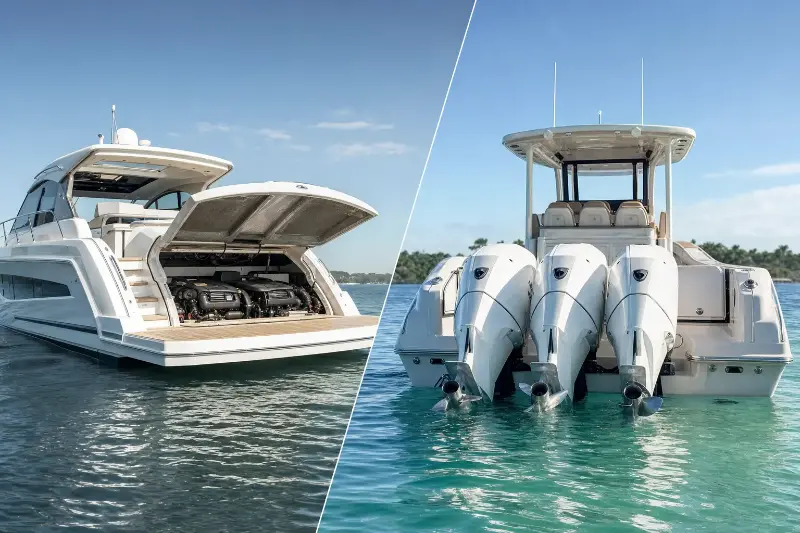
Choosing between an inboard and an outboard engine is one of those yacht decisions that looks technical, but quickly becomes personal. It shapes how the boat handles, how much space you have, where you can cruise, what you will pay every season and how calm you feel when the weather turns impolite.
The old rule was simple: small boats used outboards, serious yachts used inboards. That rule is now badly out of date. Modern outboards have become powerful, quiet and electronically sophisticated. Mercury sells a 600-horsepower V12 outboard. Yamaha and Suzuki also build large, refined engines for offshore work. At the same time, diesel inboards remain the quiet backbone of long-range cruising, especially on displacement motor yachts and sailing yachts.
The better question is not which engine is superior. It is which compromise suits the yacht and the way it will be used.
What an inboard engine really is
An inboard engine sits inside the hull. It may drive a propeller through a shaft, a saildrive, a sterndrive or a pod system, depending on the boat. On many cruising yachts, the engine is diesel, mounted low and near the center of the vessel. That placement matters. Weight low in the hull helps stability, and central mass can make a boat feel more settled in a seaway.
Inboards are common on sailing yachts because they leave the transom clean, keep the propeller immersed and provide dependable thrust when pushing into wind and chop. On motor yachts, inboards are often chosen for range, torque and durability. Diesel fuel also has more energy per gallon than gasoline, roughly around 10 to 15 percent more by volume, which helps explain why diesel remains favored for long passages.
The drawbacks are just as real. An inboard takes up interior space. It usually requires more complicated installation. Access can be awkward. A shaft seal, cooling hoses, fuel lines, exhaust runs and through-hull fittings all need attention. When something breaks, the repair may require a mechanic who can work in a hot, cramped engine room rather than a technician standing comfortably behind the boat.
What an outboard engine offers
An outboard is self-contained: engine, gearbox and propeller in one package mounted outside the hull. It can tilt out of the water, which reduces marine growth and corrosion when the boat is not running. For owners in shallow bays or on trailerable boats, that alone is a major advantage.
Outboards also simplify construction. There is no shaft log through the bottom of the boat, no internal engine bed in the traditional sense and often better usable space inside the hull. If a large outboard fails, replacement can be faster than a major inboard refit. Routine service is often easier because the mechanic can reach the engine from the dock or a lift.
The trade-off is exposure. Outboards live in spray and sun. They can be targets for theft. Their weight sits aft, which can affect trim. In a steep following sea or when the stern lifts, the propeller may ventilate more readily than a well-placed inboard prop. On some yachts, especially heavier displacement hulls, an outboard can feel like a strong arm pushing from the wrong place.
"The right engine is not the most glamorous choice on a yacht. It is the one you trust at dusk, in a crosswind, with guests aboard."
Cost: purchase price versus lifetime cost
Outboards often win on initial simplicity. A builder can rig them faster, and the owner may pay less for installation. Maintenance can also be straightforward: oil, filters, spark plugs on gasoline models, gear lube and impellers. But big modern outboards are not cheap. High-horsepower models with digital controls, joystick systems and multiple engines can turn the transom into an expensive piece of machinery.
Inboards tend to cost more to install and can be expensive to repair, but a well-maintained marine diesel may run for thousands of hours. That longevity matters for owners who cruise often or keep a yacht for many years. The arithmetic changes if the boat is used only on weekends. A lightly used coastal yacht may never justify the cost of a heavy-duty diesel installation.
Fuel, range and the cruising question
For real voyaging, inboards usually have the edge. Diesel inboards are efficient at steady load, and larger yachts can carry substantial fuel in proper tanks low in the hull. They also support onboard systems: alternators, charging, hot water, hydraulics and, in some cases, integration with generators and stabilizers.
Outboards have improved dramatically in fuel economy, especially four-stroke models. They are excellent for fast center-console-style yachts, day boats and sport cruisers that prize speed and deck space. But gasoline availability, range and fuel storage can become limiting factors in remote cruising grounds. Diesel is also less volatile than gasoline, a safety consideration on enclosed boats. Gasoline vapors are heavier than air and can collect in bilges if systems are not properly ventilated and maintained.
Handling and docking
Handling depends on the whole boat, not just the engine. Still, the differences are noticeable. Twin outboards can pivot thrust and make close-quarters maneuvering impressively easy. Joystick controls have made large outboard yachts far less intimidating at the marina.
Inboards behave differently. A single-screw inboard may have prop walk in reverse, a quirk that skilled skippers learn to use rather than fight. Twin inboards offer excellent control, especially with bow and stern thrusters. In rough conditions, an inboard propeller placed deeper and farther forward often keeps its bite better than an outboard hanging off the transom.
Noise, comfort and living aboard
Modern outboards are much quieter than they used to be, particularly at idle. But at speed, they are still mounted outside the cockpit or swim platform, and their sound signature is part of the experience. Inboards can be beautifully quiet when well insulated, though a poorly installed diesel can thrum through a hull like a subway car.
For liveaboard comfort, inboards usually fit more naturally into the yacht ecosystem. They can heat water, charge battery banks and run for long hours at steady speeds. Outboards suit owners who want clean interior volume, simple service and the ability to repower without rebuilding half the boat.
Which should you choose?
Choose an outboard if your yacht is relatively light, fast, used mostly for day trips or coastal hops, or if you value shallow-water operation and easy service access. Choose an inboard if you plan longer passages, carry heavier loads, sail offshore, or want the range and steady thrust of diesel power.
The honest answer is that both technologies are excellent when matched to the right hull. Trouble begins when fashion leads the decision. Outboards are currently popular, and for good reasons. But popularity is not naval architecture. A yacht is a system, and the engine is only one part of that system.
The best owners ask practical questions. How far will I cruise? Who can service this engine where I keep the boat? How much weight belongs on the stern? What happens in bad weather? What will this cost five years from now?
That is where the debate ends. Not with a winner, but with a use case. On yachts, the best engine is not the one that impresses at the dock. It is the one that quietly expands your confidence once the dock is gone.